The Missing Layer Between Federal AI Strategy and Federal AI Results
Why platform engineering is the foundation your agency’s AI mandate is quietly waiting on — and what it takes to build one.
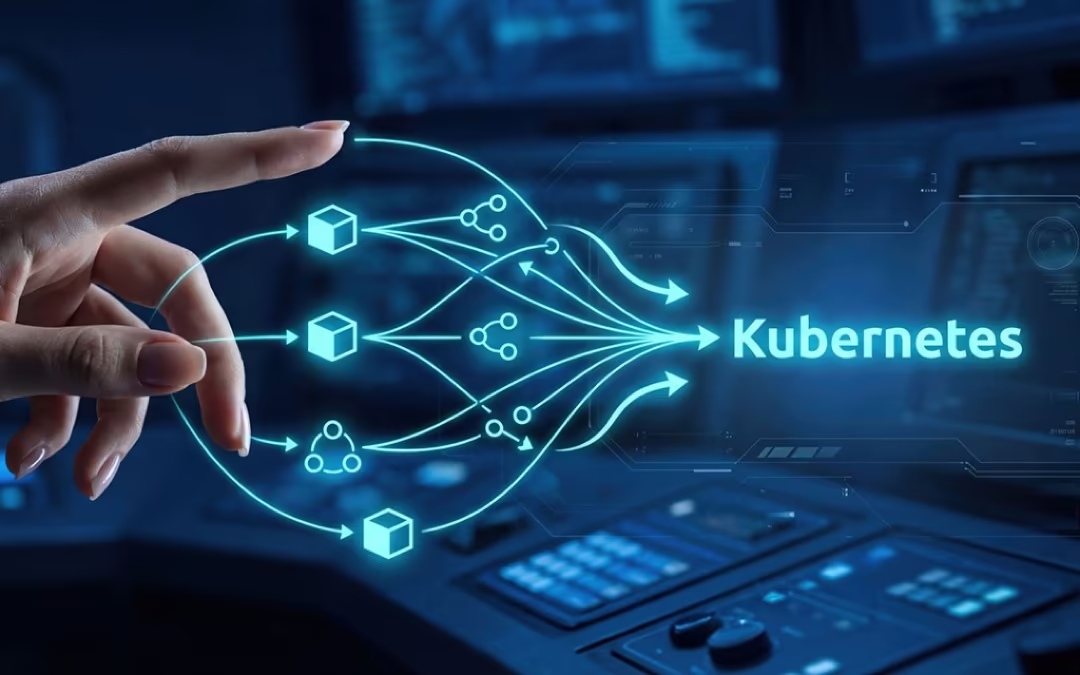
Most federal agencies have an AI mandate. Few have a platform that can ship one. The missing layer is platform engineering.
KEY TAKEAWAYS
- Most federal AI programs stall not on models or data but on a delivery platform that was never built for AI iteration speed.
- Platform engineering builds an internal product — a paved road — that limits primitives, absorbs glue work, centralizes migrations, and lets teams operate what they build.
- A platform that works has five traits: a curated product approach, software-based abstractions, a service catalog, serving the median team, and operating as mission-critical infrastructure.
Every federal agency is now under pressure to do something with AI. OMB memos demand it. CIOs are measured on it. Vendors are pitching it relentlessly. And yet, eighteen months into the wave, most agency AI programs look the same: a handful of impressive pilots, a growing inventory of use cases, and very little that has crossed into production at scale.
The reflex is to blame the models, the data, or the procurement timelines. The honest answer is more uncomfortable: the underlying engineering platform is not ready. Federal IT environments built up over twenty years of incremental modernization were never designed for the rate of iteration that AI workloads demand. Until that foundation is fixed, every AI initiative inherits the friction of the floor it stands on.
This is the gap that platform engineering closes. It is not a tooling category, not a re-skinning of DevOps, and not a synonym for cloud migration. It is a deliberate engineering discipline that builds an internal product — a paved road for delivery — whose users are the agency’s own developers, data scientists, and mission teams. Done well, it is the difference between AI that ships and AI that demos.
Why Federal AI Programs Stall
Walk into almost any federal IT shop and you will find what platform engineers call the over-general swamp. Cloud and open source gave teams an effectively infinite menu of primitives. Need a queue? There are twelve. Need a vector database, a model registry, a feature store, a CI runner, an inference endpoint? Pick a flavor. Each program office picks differently.
A year later, the agency’s environment is a tangle of glue code where every system has its own deploy pipeline, its own retry logic, its own monitoring conventions, and its own subtly wrong IAM bindings. Twenty programs end up with twenty almost-identical implementations of the same landing zone, each with its own bugs and its own ATO timeline.
This is not a hypothetical. Across the work we do on landing zones, DevSecOps pipelines, and SharePoint and Microsoft 365 modernization, the pattern repeats: capable teams reinventing the same plumbing in parallel because no one made a decision about what the agency should standardize on. The cost is invisible until the agency tries to do something hard, like deploy AI at scale. Then it becomes the only thing that matters.
The platform team builds and operates an internal product whose users are the agency’s own engineers. Treat it as anything less and you get tools nobody adopts.
What Platform Engineering Actually Is
A platform team does four specific things, and the work either delivers on all four or it is not a platform:
- Limits the primitives developers see. They do not get raw S3 plus raw SQS plus raw Lambda; they get a curated, opinionated way to combine them that already meets the agency’s security baseline.
- Reduces per-application glue by absorbing the repetitive plumbing — logging, secrets, identity, network policy — into shared services that every workload inherits.
- Centralizes the cost of migrations. When the underlying primitive changes, or a new compliance requirement lands, the platform team handles it once instead of fifty program teams handling it badly in parallel.
- Lets teams operate what they build without forcing every developer to become a Linux kernel hobbyist or a Kubernetes specialist.
This is also why platform engineering is not just DevSecOps with a portal. DevSecOps said “developers, take ownership of operations and security.” Platform engineering says “agreed — and we will give you good tools to do that, and treat those tools as a real product with real users, real SLOs, and a real roadmap.”
Why This Is the Difference Between AI Pilot and AI Production
AI workloads are uniquely punishing on weak platforms. They demand fast iteration, reproducible environments, GPU and accelerator orchestration, model lineage tracking, prompt and output logging for audit, and tight integration with identity and data governance. They also demand all of this under FedRAMP, FISMA, and increasingly under the controls outlined in NIST AI RMF and OMB M-24-10.
On a strong platform, an agency data scientist can stand up a sandboxed environment, pull from approved data sources, train a model, register it, deploy it behind an authenticated inference endpoint, and have observability and audit logging from minute one. The platform handles the boring parts. The team focuses on the mission.
On a weak platform, the same workflow takes months. Each pilot becomes a custom integration project. Security review starts from scratch. Production handoff requires an entirely new architecture. The pilot ships a slide deck instead of an outcome. The 2025 DORA Report found that platform quality is now a direct predictor of whether AI tooling produces value or chaos. That finding maps onto federal experience exactly: agencies with mature platforms are operationalizing AI; agencies without them are accumulating pilots.
A bad platform makes AI tools amplify chaos. A good platform makes them amplify throughput. Build the floor before you build the rocket.
The Five Pillars of a Platform That Works
Across the federal programs where we have seen platform thinking succeed, the same five characteristics show up. Missing any one of them turns the effort back into a tools project.
1. A Curated Product Approach
The platform team decides, with intent, what is supported and what is not. If a program office wants Kafka instead of the agency’s standard event service, the answer is not “sure, here are the docs.” The answer is “here is what we support, here is why, and here is the off-ramp if your case really does not fit.” Saying no is part of the job. In federal contexts, where every exception becomes a permanent supportability burden, this discipline matters even more.
2. Software-Based Abstractions
The platform is software, not a wiki. The interface is APIs, CLIs, and SDKs. A program team should be able to provision a production-grade, ATO-aligned service by writing a small declarative file — not by clicking through a console, filing tickets, or reading a 200-page deployment guide. This is what closes the lead-time gap that makes AI iteration possible.
3. A Service Catalog and Metadata Registry
Without a single source of truth for what services exist, who owns them, and what they depend on, the platform is flying blind. Every audit, every incident, every migration becomes archaeology. A real metadata registry — Backstage, Port, or an equivalent — turns the agency’s environment from a mystery into a map.
4. Serving the Median Team, Not the Loudest One
Every agency platform has a small number of very loud customers — usually the team running the highest-profile system, who will demand exotic features. Resist. The platform exists to serve the median program doing the median task, well. If you build only for the elite users, the long tail of programs will work around you, and that is how shadow IT gets reinvented inside the agency that swore it had killed shadow IT.
5. Operating as a Foundation
If the platform is down, the agency’s mission delivery is down. That changes everything: real 24/7 coverage, real SLOs, real change management, real support tiers. The platform is not “a tool.” It is the floor. Anything built on top assumes the floor holds. Funding and staffing models have to reflect that.
What Federal IT Leaders Should Do Now
Platform engineering is not a six-month project, and it is not something an agency can buy off the shelf. It is a multi-year capability investment. But the first moves are concrete, and the agencies that get them right in the next twelve months will be the ones whose AI portfolios actually deliver.
Decide What You Support — and Defend It
Pick the cloud, the runtime, the CI/CD pattern, the identity provider, the observability stack, and the data services your agency will treat as standard. Write it down. Communicate it. Hold the line. Every exception you grant in year one becomes a maintenance tax in year three.
Invest in Real Software Abstractions, Not More Documentation
Wikis do not scale. The agencies that have made progress on platform engineering have invested in actual software — provisioning APIs, golden-path templates, opinionated SDKs — that encode the right answer once and let it be reused everywhere. This is also where AI assistance starts to compound: an opinionated platform is the substrate that makes AI-augmented development safe and productive.
Stand Up a Service Catalog Early
Before the platform can serve customers, you need to know who they are and what they run. A working service catalog with ownership, dependencies, and runtime metadata is the single highest-leverage early investment. It pays back in audit response, incident management, and migration planning long before the platform itself is mature.
Treat Operations as a First-Class Feature
On-call, support tiers, SLOs, and synthetic monitoring are not things you bolt on later. The platform needs them from day one, because the moment a program team depends on it for production, the platform has become mission-critical infrastructure. Funding has to follow.
Build for the Median Mission Team
Most agency programs do not need exotic capabilities. They need to ship a containerized application, hook up a database, integrate with the agency’s identity system, log everything to the right place, and pass their security review. A platform that nails that experience for the 80 percent will earn the trust to take on the harder cases later.
Communicate Ruthlessly
Platform teams die in silence. The teams that succeed publish biweekly wins-and-challenges updates, run honest stakeholder reviews, and make their roadmap legible to leadership. In federal contexts, where stakeholder maps are unusually complex and budget cycles are unforgiving, this discipline is not optional.
How One Dynamic Approaches This Work
We bring this perspective to every federal engagement, whether the contract is labeled cloud modernization, DevSecOps, AI enablement, or data and analytics. The label changes; the underlying problem rarely does. Agencies need a delivery foundation that lets their mission teams move quickly and safely, and they need partners who treat that foundation as a product rather than a one-time deployment.
Our work across AWS Cloud and DevSecOps, Microsoft 365 and SharePoint, Data and Analytics, and AI and Automation is structured around the same principles a strong platform team uses internally: curate the primitives, encode the right answers in software, instrument everything, serve the median user, and operate the result as if the mission depends on it — because it does.
As a Service-Disabled Veteran-Owned Small Business serving federal customers, we bring engineering rigor with the agility of a small business and the accountability of a partner who shows up to the standups. If your agency is staring at an AI mandate and wondering why the pilots are not converting, the answer is almost always upstream of the AI itself. We can help you build the floor.
Frequently Asked Questions
What is platform engineering and why does federal AI depend on it?
Platform engineering is the discipline of building an internal, product-managed paved road for delivery whose users are the agency's own engineers. AI workloads demand fast iteration, reproducible environments, and tight governance; on a weak platform each AI pilot becomes a custom integration project that never reaches production.
How should a federal agency start a platform-engineering effort?
Decide what you support and defend it, invest in real software abstractions over documentation, stand up a service catalog early, treat operations as a first-class feature, build for the median mission team, and communicate progress relentlessly.
Ready to discuss your challenges?
Contact One Dynamic to explore how we can help your organization.
CONTACT ONE DYNAMIC